





Key Concept
Enfant Terrible – A person whose unconventional or controversial behavior or ideas shock, embarrass, or annoy others.
Change is such a fundamental feature of our everyday experience that it may be hard to see what could be puzzling about it. Many of the ancient Greek philosophers, however, were puzzled. In fact, one group, the Eleatics, was so puzzled that they believed change to be impossible. Here is one of their arguments, from the founder of the Eleatic school, Parmenides: change involves something’s coming into being that was not in being before, that is, a transition from not being to being, from what is not to what is; but that is absurd, since to come to be from not being is to come to be from nothing, and nothing comes to be from nothing. Try to think about what is right or wrong about this argument.
Aristotle (384-322 BC) was an ancient Greek philosopher. Originally from Stagira in northern Greece, he moved to Athens to study with Plato at the Academy where he remained for twenty years until his teacher’s death. After some time away from the city — including a stint in Macedonia tutoring the young Alexander the Great — he returned to found his own school, the Lyceum. Most of the works of Aristotle that come down to us probably consist of notes put together in connection with instruction at the Lyceum. Aristotle’s philosophy went into temporary eclipse during the Hellenistic period (323–31 BC), but later reemerged as perhaps the single most formative influence on the Western philosophical tradition. Contemporary philosophers continue to benefit from his insights.
Here we will be looking at a foundational text within Aristotle’s natural philosophy, Book I of the Physics. Do not be misled by the title: Aristotle’s concerns in this work have only very limited overlap with those of the modern scientific discipline of physics. Rather, Aristotle is concerned with philosophical questions about the natural world in general (in Greek, “physics” (physica) just means “natural things”).
Book I primarily concerns change: Aristotle wants to uncover what the basic explanatory starting points are for understanding the natural world, understood broadly as everything that is subject to change. Thus, after some methodological remarks (I.1), Aristotle first argues against the Eleatics, who denied that change occurs (I.2–3). Having rejected this view, he sifts through what his predecessors said who did not deny but tried to explain change (I.4–6). Then he gives his own view (I.7). Finally, he shows how his view clears up some of the confusions created by the Eleatics (I.8) and Plato (I.9). Because Aristotle does so much in these chapters, we will focus here just on I.1, I.7, and I.8.
Underlier (Greek hypokeimenon) – in Aristotle’s account of change, what remains constant throughout the change and by which form is acquired and privation is lost. For instance, if Socrates becomes musical from being unmusical, Socrates is the underlier. (N.B. This same Greek term is also, especially in logical and metaphysical contexts, often translated as “subject”.)
Principle (Greek archē) – a starting point; in particular, something that we start from when explaining the world.
Form (Greek eidos) – the feature that, in Aristotle’s account of change, is acquired by the underlier in the process of the change (also called “shape” (Greek morphē)). For instance, when Socrates becomes musical, the musical (or musicality) is the form.
Privation (Greek sterēsis) – in Aristotle’s account of change, the underlier’s state of lacking the form that it will acquire in the change. Thus, when Socrates becomes musical, he starts out being unmusical, that is, lacking musicality, and this lack is the privation.
Substance (Greek ousia) – the most fundamental sort of being in Aristotle’s ontology. Substances correspond roughly to what we would commonsensically treat as objects, like Secretariat the horse and Methuselah the redwood tree, as opposed to attributes of objects, like the greenness of Methuselah’s leaves, or collections of objects, like heaps of sand.
Substantial Change – change with respect to an object’s essence, that is, with respect to what the object is. As a result of substantial change, objects go in and out of existence. For instance, when Socrates is killed, this is a substantial change.
Accidental Change – change with respect to accidents. Accidents are features of an object that are not essential, i.e., do not pertain to what the object is. For instance, if Socrates becomes pale, he undergoes an accidental change, because pallor is an accident of Socrates. It is an accident because Socrates is a human being and being pale is no part of being a human being.
Hylomorphism – the view that objects are composed of matter (Greek hylē) and form (Greek morphē).
In I.1, Aristotle introduces us to his project of “natural philosophy” (physikē), or the science of Nature, of which Physics I is the first installment. Aristotle tells us that, quite generally, if we want scientific knowledge about some subject matter, we must first identify the principles appropriate to that subject matter; thus, since our science — the science of Nature — is about natural things, if we want scientific knowledge about natural things, we must first identify the principles of natural things.
Book 1.1
When the objects of an inquiry, in any department, have principles, conditions, or elements, it is through acquaintance with these that knowledge, that is to say scientific knowledge, is attained. For we do not think that we know a thing until we are acquainted with its primary conditions or first principles, and have carried our analysis as far as its simplest elements. Plainly therefore in the science of Nature, as in other branches of study, our first task will be to try to determine what relates to its principles.
The natural way of doing this is to start from the things which are more knowable and obvious to us and proceed towards those which are clearer and more knowable by nature; for the same things are not ‘knowable relatively to us’ and ‘knowable’ without qualification. So in the present inquiry we must follow this method and advance from what is more obscure by nature, but clearer to us, towards what is more clear and more knowable by nature.
Aristotle here lays down a claim that will guide the ensuing inquiry: in order to gain scientific knowledge of Nature, we must first identify the principles of natural things. In considering Aristotle’s claim, it will be helpful to keep the following points in mind.
First, an Aristotelian science is not the same as what we think of as a science today. What makes a branch of knowledge a science for Aristotle is not that it rests on a special empirical method, but that it gives us a certain kind of deep understanding of its subject matter. This deep understanding comes from grasping why something is the case and cannot be otherwise — that is, a certain kind of explanation. For Aristotle, then, the fundamental aim of any science is explanation of why the subject matter of the science must be as it is. In any given science, the explanations constituting that science will need to be traced back to some starting points, that is, to things that we use to explain other things but which are not themselves explained (at least within that science). Otherwise, the explanation would go on forever and we would never arrive at understanding. These starting points are Aristotle’s principles.
Second, while, when we hear “principle,” we tend to think of claims that we might start from in giving explanations (e.g., the claim that all objects are made of atoms), Aristotle usually (though not always) has in mind the entities that we cite at the ground level of our explanations (e.g., the atoms themselves).
Finally, it is important that, for Aristotle, the sort of explanation we are after is objective: what counts as an adequate explanation depends purely on the way the world is, not our concerns, interests, or epistemic situation. This is why, as Aristotle points out in this passage, there can be a mismatch between the objective starting points for scientific explanation that we are trying to uncover (“more knowable by nature”) and what we have to start from when trying to uncover these objective principles (“more knowable to us”). When Aristotle says our first task must be to identify the principles, it is the former, objective starting points he has in mind, though it is the latter, subjective starting points we have to start from in order to discover the objective starting points.
After discussing the views of his predecessors about change or becoming, Aristotle begins to develop his own view in I.7. Aristotle’s initial analysis considers how we speak about change.
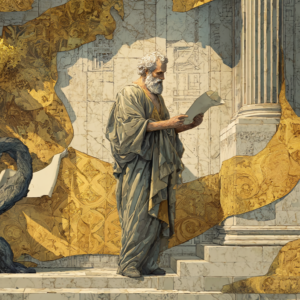
Book 1.7
We will now give our own account, approaching the question first with reference to becoming in its widest sense: for we shall be following the natural order of inquiry if we speak first of common characteristics, and then investigate the characteristics of special cases.
We say that one thing comes to be from another thing, and one sort of thing from another sort of thing, both in the case of simple and of complex things. I mean the following. We can say (1) ‘man becomes musical’, (2) what is ‘not-musical becomes musical’, or (3), the ‘not-musical man becomes a musical man’. Now what becomes in (1) and (2)—’man’ and ‘not musical’—I call simple, and what each becomes—’musical’—simple also. But when (3) we say the ‘not-musical man becomes a musical man’, both what becomes and what it becomes are complex. As regards one of these simple ‘things that become’ we say not only ‘this becomes so-and-so’, but also ‘from being this, comes to be so-and-so’, as ‘from being not-musical comes to be musical’; as regards the other we do not say this in all cases, as we do not say (1) ‘from being a man he came to be musical’ but only ‘the man became musical’.
When a ‘simple’ thing is said to become something, in one case (1) it survives through the process, in the other (2) it does not. For man remains a man and is such even when he becomes musical, whereas what is not musical or is unmusical does not continue to exist, either simply or combined with the subject.
Aristotle is pointing out that when we say that X becomes Y (or that Y comes to be from X), we are distinguishing an initial state (X) from a final state (Y). Moreover, when we do this, sometimes X and Y have only one component, making them simple, while at other times they have two, making them complex. Thus, in Aristotle’s toy example, in which a man becomes musical, we have:
Simple (initial): the man, the unmusical
Simple (final): the musical
Complex (initial): the unmusical man
Complex (final): the musical man
Aristotle is especially interested in highlighting the fact that only one of these things is something that remains (Greek hypomenon) throughout the whole change: the man. By contrast, among the other simple things, one is lost in the change (the unmusical), while the other is acquired (the musical), and, since the complex things will always include at least one item other than what remains (the man), they will also either cease to be or come into being.
Note Aristotle’s focus in this section on what we say, i.e., how we talk about change. In a moment, Aristotle will begin to draw conclusions about what is true about all changes. It is worth thinking carefully about what Aristotle’s implicit move is here and whether it is justified.
Aristotle now wants to convince us that every change involves something that underlies (Greek hypokeisthai) the change, or is an underlier (Greek hypokeimenon). The underlier is the item in the initial analysis that remained throughout the change. Aristotle describes this item as one in number, but not in form and account: when Socrates becomes musical, there is one thing, Socrates, that is now unmusical and now musical, but to be unmusical is not the same thing as to be musical.
Book 1.7 (continued)
These distinctions drawn, one can gather from surveying the various cases of becoming in the way we are describing that, as we say, there must always be an underlying something, namely that which becomes, and that this, though always one numerically, in form at least is not one. (By that I mean that it can be described in different ways.) For ‘to be man’ is not the same as ‘to be unmusical’. One part survives, the other does not: what is not an opposite survives (for ‘man’ survives), but ‘not-musical’ or ‘unmusical’ does not survive, nor does the compound of the two, namely ‘unmusical man’. […]
But there are different senses of ‘coming to be’. In some cases we do not use the expression ‘come to be’, but ‘come to be so-and-so’. Only substances are said to ‘come to be’ in the unqualified sense.
Now in all cases other than substance it is plain that there must be some subject, namely, that which becomes. For we know that when a thing comes to be of such a quantity or quality or in such a relation, time, or place, a subject is always presupposed, since substance alone is not predicated of another subject, but everything else of substance.
But that substances too, and anything else that can be said ‘to be’ without qualification, come to be from some substratum, will appear on examination. For we find in every case something that underlies from which proceeds that which comes to be; for instance, animals and plants from seed.
Generally things which come to be, come to be in different ways: (1) by change of shape, as a statue; (2) by addition, as things which grow; (3) by taking away, as the Hermes from the stone; (4) by putting together, as a house; (5) by alteration, as things which ‘turn’ in respect of their material substance.
It is plain that these are all cases of coming to be from a substratum.
To convince us that there is always an underlier, Aristotle distinguishes two sorts of change, corresponding to one-place and two-place uses of the verb “to come to be”: in the one-place use, we say something (like a human) comes to be period. In the two-place use, we say something (like a sick man) comes to be something else (a healthy man). According to Aristotle, only substances can be subjects of one-place coming to be. He then argues that both one- and two-place coming to be presuppose some underlier persisting through the change. Aristotle’s argument here is a constructive dilemma:
Premise 1: Two-place coming to be presupposes something underlying the change.
Premise 2: One-place coming to be presupposes something underlying the change.
Premise 3: All change is either one-place coming to be or two-place coming to be.
Conclusion: All change presupposes something underlying the change.
Aristotle’s argument for Premise 1 is brief: he says it is obvious because, in two-place coming to be, something always comes to be something else, and that first “something” is what underlies the change. In other words, it is obvious because one of the two-places in two-place coming to be is reserved for the underlier.
Most of the passage is reserved to argue for Premise 2. Aristotle argues that it is clear if we look at individual cases that, even though in one-place coming to be the underlier does not show up linguistically as the subject, there nonetheless always is an underlier from which the thing comes to be. He strengthens this by considering some of the many ways by which things come to be (by putting together various parts, etc.). When we consider these ways, he says, it is obvious that they involve something remaining through the change (the building materials that are put together, etc.).
Aristotle now applies his account of change to draw some conclusions about the principles of natural things. This is the peak of Book I,since it fulfills I.1’s goal of identifying the natural principles or starting points. It should therefore be read extremely carefully.

Book I.7 (continued)
Thus, clearly, from what has been said, whatever comes to be is always complex. There is, on the one hand, (a) something which comes into existence, and again (b) something which becomes that-the latter (b) in two senses, either the subject or the opposite. By the ‘opposite’ I mean the ‘unmusical’, by the ‘subject’ ‘man’, and similarly I call the absence of shape or form or order the ‘opposite’, and the bronze or stone or gold the ‘subject’.
Plainly then, if there are conditions and principles which constitute natural objects and from which they primarily are or have come to be-have come to be, I mean, what each is said to be in its essential nature, not what each is in respect of a concomitant attribute-plainly, I say, everything comes to be from both subject and form. For ‘musical man’ is composed (in a way) of ‘man’ and ‘musical’: you can analyse it into the definitions of its elements. It is clear then that what comes to be will come to be from these elements.
Now the subject is one numerically, though it is two in form. (For it is the man, the gold-the ‘matter’ generally-that is counted, for it is more of the nature of a ‘this’, and what comes to be does not come from it in virtue of a concomitant attribute; the privation, on the other hand, and the contrary are incidental in the process.) And the positive form is one-the order, the acquired art of music, or any similar predicate.
There is a sense, therefore, in which we must declare the principles to be two, and a sense in which they are three; a sense in which the contraries are the principles-say for example the musical and the unmusical, the hot and the cold, the tuned and the untuned-and a sense in which they are not, since it is impossible for the contraries to be acted on by each other. But this difficulty also is solved by the fact that the substratum is different from the contraries, for it is itself not a contrary. The principles therefore are, in a way, not more in number than the contraries, but as it were two, nor yet precisely two, since there is a difference of essential nature, but three. For ‘to be man’ is different from ‘to be unmusical’, and ‘to be unformed’ from ‘to be bronze’.
We have now stated the number of the principles of natural objects which are subject to generation, and how the number is reached: and it is clear that there must be a substratum for the contraries, and that the contraries must be two. (Yet in another way of putting it this is not necessary, as one of the contraries will serve to effect the change by its successive absence and presence.)
Having defended the claim that there is always an underlier for every change, Aristotle now affirms that the same holds for the roles of the other simple items he distinguished in his initial analysis. The initial analysis, then, according to Aristotle, reveals three principles of natural things. They are:
Underlier (or substratum or matter): this is what remains throughout and acquires something new in the change
Form (or shape): this is the feature that is acquired by the underlier in the change
Privation: this is the lack of form in the underlier at the beginning of the change; as such, it is opposite to (Greek antikeimenon) or contrary to (Greek enantion) the form.
Aristotle is particularly interested in the following result of this analysis: anything that has come to be must be composite or complex, comprised of both an underlier and a form. In particular, since, as Aristotle has been at pains to show, his analysis applies not just to accidental change but also to substantial change, we can conclude that substances like plants and animals are themselves composites of form and matter. This is what is often called Aristotle’s hylomorphism. Aristotle will more fully develop this aspect of his view later in the Physics and in the Metaphysics.
Now that Aristotle has his own view of change in hand, he turns to consider the Parmenidean puzzle with which we began. Aristotle wants to suggest that his own analysis helps us clear away the mental confusions that lend Parmenides’ puzzle its plausibility.
Book I.8
We will now proceed to show that the difficulty of the early thinkers, as well as our own, is solved in this way alone.
The first of those who studied science were misled in their search for truth and the nature of things by their inexperience, which as it were thrust them into another path. So they say that none of the things that are either comes to be or passes out of existence, because what comes to be must do so either from what is or from what is not, both of which are impossible. For what is cannot come to be (because it is already), and from what is not nothing could have come to be (because something must be present as a substratum). So too they exaggerated the consequence of this, and went so far as to deny even the existence of a plurality of things, maintaining that only Being itself is. Such then was their opinion, and such the reason for its adoption.
Our explanation on the other hand is that the phrases ‘something comes to be from what is or from what is not’, ‘what is not or what is does something or has something done to it or becomes some particular thing’, are to be taken (in the first way of putting our explanation) in the same sense as ‘a doctor does something or has something done to him’, ‘is or becomes something from being a doctor.’ These expressions may be taken in two senses, and so too, clearly, may ‘from being’, and ‘being acts or is acted on’. A doctor builds a house, not qua doctor, but qua housebuilder, and turns gray, not qua doctor, but qua dark-haired. On the other hand he doctors or fails to doctor qua doctor. But we are using words most appropriately when we say that a doctor does something or undergoes something, or becomes something from being a doctor, if he does, undergoes, or becomes qua doctor. Clearly then also ‘to come to be so-and-so from not-being’ means ‘qua not-being’. It was through failure to make this distinction that those thinkers gave the matter up, and through this error that they went so much farther astray as to suppose that nothing else comes to be or exists apart from Being itself, thus doing away with all becoming. We ourselves are in agreement with them in holding that nothing can be said without qualification to come from what is not. But nevertheless we maintain that a thing may ‘come to be from what is not’-that is, in a qualified sense. For a thing comes to be from the privation, which in its own nature is not-being,-this not surviving as a constituent of the result. Yet this causes surprise, and it is thought impossible that something should come to be in the way described from what is not.
In the same way we maintain that nothing comes to be from being, and that being does not come to be except in a qualified sense. In that way, however, it does, just as animal might come to be from animal, and an animal of a certain kind from an animal of a certain kind. Thus, suppose a dog to come to be from a horse. The dog would then, it is true, come to be from animal (as well as from an animal of a certain kind) but not as animal, for that is already there. But if anything is to become an animal, not in a qualified sense, it will not be from animal: and if being, not from being-nor from not-being either, for it has been explained that by ‘from not being’ we mean from not-being qua not-being.
Parmenides, according to Aristotle, advances the following, paradoxical argument:
Premise 1: If something comes to be, it comes to be from what is or from what is not.
Premise 2: If it comes to be from what is, it is already.
Premise 3: Nothing comes to be from what is already.
Premise 4: If it comes to be from what is not, then it comes to be from nothing.
Premise 5: Nothing comes to be from nothing.
Conclusion: Nothing comes to be.
The argument is a destructive dilemma: if p is true, there are two possibilities, q and r; since, then, neither q nor r holds, we can conclude that p does not hold.
Aristotle in this chapter develops a resolution to this paradoxical argument. Effectively, Aristotle thinks that these claims need to be disambiguated, and that once we do so, the argument collapses.
Suppose a horse comes to be. According to the analysis of I.7, it comes to be from the privation of the horse’s form. But a privation, as we have seen, is a lack or absence of something, and a lack or absence is a way of not being. In this sense, then, the horse comes to be from not being. However, the horse does not come to be from the privation just qua (i.e., insofar as it is) not being, but qua privation of the form of a horse. But Premise 5 is true only in the sense that nothing comes to be from not being qua not being.
Likewise for coming to be from what already is. Suppose a house comes to be. According to the analysis of I.7, it comes to be from an underlier that currently is deprived of the form of a house. This underlier is something, for instance, bricks, and being bricks is a way of being. In this sense, then, the house comes to be from being and so from what already is. However, the house does not come to be from this underlier just qua (i.e., insofar as it is) a being. But Premise 3 is true only in the sense that nothing comes to be from a being just qua a being.
In sum: properly understood, there is nothing paradoxical or contradictory about the fact that a house (say) comes to be both from what is not (namely, what is not yet a house) and what is (namely, what already is bricks and stones).
In Book I of the Physics, Aristotle uses an investigation of change to isolate the principles — that is, the explanatory starting-points — of natural things. According to Aristotle, all change involves three principles: something underlying the change, some feature that underlying thing takes on, and an initial state of lack of that feature. A key upshot of this analysis is that natural objects are composites: since they come to be, they have something that was the underlier for their coming to be (the matter) and something acquired in their coming to be (the form). This is an insight that will prove foundational to Aristotle’s understanding of the natural world. In the remainder of the Physics, he will further develop his account of matter, form, and change, as well as various related concepts such as place, void, and time.
First-time readers may find Aristotle’s focus on whether there are two or three principles in I.7 odd, even distracting, but it reflects something important about Aristotle’s method: Aristotle is attempting here to suggest that his position improves on that of his predecessors while incorporating their insights. The basic move is this. Aristotle, in I.4–6, discussed philosophers who make the principles to be contraries (e.g., hot and cold), as well as those who posited a third principle in addition to serve as a subject to the contraries (e.g., air, which undergoes changes in density and rarity).
Aristotle sets up a tension between these two views. On the one hand, change seems to be by its nature a transition from opposite to opposite: things change from white to black and hot to cold, not from white to cold (188a30–b26). (Of course, something that happens to be white might change from hot to cold, but this is not the same thing as its changing from white to cold.) On the other hand, there are reasons to think this appeal to opposites is inadequate. For instance, opposites do not directly act on each other: heat does not heat up coldness; rather, heat heats up things that are cold (189a20–6). Aristotle thinks his view’s superiority can be seen in part by the fact that it harmonizes both views: because privation and underlier are in a way one principle, there remains a sense in which it is right that the change only has two principles and that these are opposites, even while in another sense there is a third principle distinct from both opposites.
This is a very common pattern of argument for Aristotle: describe the views of earlier philosophers, develop arguments showing both why they are plausible and why they give rise to problems, and then attempt a resolution that synthesizes their insights while avoiding their problems. At least part of the motivation for this pattern comes from Aristotle’s conviction that his predecessors were unlikely to have completely missed the truth (compare Metaphysics II.1 993a30–b5). Think about whether and how far you agree with Aristotle’s attitude.
Those wishing to read more of Aristotle’s natural philosophy are encouraged to continue reading the Physics — especially Book II (on nature, causality, chance, and teleology). Those who want a deeper understanding of Physics Book I and are interested in reading some secondary literature on the text might profitably begin with a recent collection of essays: Aristotle’s Physics Book I: A Systematic Exploration ed. Dianna Quarantotto (Cambridge: Cambridge University Press, 2017).
Citations of Aristotle’s text are from the Oxford Translation of Aristotle’s Physics by R. P. Hardie and R. K. Gaye, hosted by the Internet Classics Archive at MIT. This work is in the public domain. All images were created using Midjourney.
Hobbs, Landon. 2026. “The More Things Change the More They Stay the Same: Aristotle’s Physics, Book I.” The Philosophy Teaching Library. Edited by Robert Weston Siscoe, <https://thephilosophylibrary.org/article/the-more-things-change>.
Dead Hypothesis – an impossibility for our belief; one that does not tempt our will.
Live Hypothesis – a real possibility for our belief; one that tempts our will.
Hypothesis – anything that may be proposed to our belief.
Underlier (Greek hypokeimenon) – in Aristotle’s account of change, what remains constant throughout the change and by which form is acquired and privation is lost. For instance, if Socrates becomes musical from being unmusical, Socrates is the underlier. (N.B. This same Greek term is also, especially in logical and metaphysical contexts, often translated as “subject”.)
Relations of Ideas – these are claims we come to believe without any sensory experience required. For instance, we can come to realize that a circle has a perfect center point without discovering any perfect circles in the world. All we need to do is think clearly about what it means to be a circle!
Here, Kant refers to Frederick the Great (Friedrich II, 1712-1786), who was King of Prussia. A supporter of the Enlightenment, Frederick endorsed social and political change by abolishing torture and expanding the educational sector. He suspended censorship for newspapers with the exception of political content. Supporting freedom of religion in general, he nevertheless favored protestants for political higher office and did not grant Jews civil rights.
Monarchy – A monarchy is a state where political deliberation is performed by one person (generally a king or queen).
Phalaris (c. 570-549 BCE) was, by most accounts, the very opposite of Cyrus, and he was used as an example of tyrannical cruelty in antiquity. He was tyrant of Acragas (now Agrigento) in Sicily. Diodorus Siculus records an infamous account of Phalaris’s torturing his enemies in a bronze bull placed over a roaring fire.
Cyrus the Great (d. 530 BCE) was the first emperor of the Persian Empire and a commonly used exemplar of the “enlightened monarch” in antiquity. He was renowned for his tolerance and care for his subjects. Xenophon, a student of Socrates, wrote a partly fictionalized biography of Cyrus called The Education of Cyrus (Cyropaedia). Peter Drucker, an influential 20th-century management theorist, called the Cyropaedia the best book on leadership.
Republic (res publica) – Cicero’s short definition of res publica is res populi (the ‘people’s thing’). Later in the Republic, Cicero famously defines a republic (1.39) as an assemblage of people associated with each other by consensus on justice (ius) and mutual benefit (utilitas).
Scipio Aemilianus Africanus was a hero among many Romans, but his reputation today is far less straightforward. Scipio Aemilianus led a Roman military campaign resulting in the utter destruction of the city of Carthage in 146 BCE. The Carthaginians were a prosperous Phoenician people in North Africa and rivals to Roman power. It has been argued that this act of ‘national extermination’ meets the modern definition of genocide. How should this knowledge impact how we view Scipio’s political philosophy expressed here?
This famous phrase, known by the abbreviation SPQR (senatus populusque Romanus), served as something like the official title of the Roman state (compare ‘USA’, ‘USSR’, ‘UK’), and encapsulated the ideal of a res publica (common property in public hands shared between the people and a council of elders).
Contemplation: The activity of human beings’ rationality. Contemplation is more than just thinking; it’s thinking excellently about ultimate truths. Contemplation is the ultimate activity associated with human flourishing.
Eudaimonia: Often translated as ‘happiness’ (in this text) or ‘flourishing’, eudaimonia is the activity of living the best possible life for a human being. Eudaimonia is more than just feeling happy or contented – it’s the idea that there is a best way to live for human beings.
Virtue: Virtues are cultivated tendencies to perform our function excellently, which allow us to reliably do the right thing, to the right extent, for the right reasons, given the demands of a specific circumstance. There are three components of virtues: virtues involve (a) skillful activity – they’re excellences after all!, (b) proper motivation, and (c) appropriate judgment – they often lead to judgments about what is the right thing to do, which requires careful attention to the circumstances.
Pleasure: The enjoyable feeling that accompanies some activities. Some philosophers (but not Aristotle!) think that pleasure is the only thing that is good in itself
Endoxic Method: An argumentative structure that begins by laying out the endoxa, or the beliefs of the many or the wise, then raises apparent problems for those views and develops a resolution to those problems.
The Problem of Induction: A problem for reasoning about the future based on past experiences. How can we be justified in believing that patterns of events in the past will continue into the future?
A Priori: Hume is using the term ‘a priori’ to denote the kind of reasoning that allows one to gain knowledge as relations of ideas—in other words, reasoning from one necessary, definitional truth to another.
Justification: the concept of justifying one’s thinking, or one’s beliefs, is important in epistemology. Roughly, one’s thinking or belief is justified when there is good reason for it, or when it is well supported or well evidenced. All of these are ways of referring to some connection between what we think or believe and what is, or to some way of at least making ourselves think that we are closer to the truth.
Inference: The psychological process of moving from one thought to another, such as moving from the thought “it’s raining, and I don’t want to get wet” to “I should get my umbrella”, or from “I am tired, and it’s getting late” to “I should get some sleep”. Nowadays, philosophers tend to use the term ‘inference’ to mean the same as ‘reasoning’, and tend instead to use the term ‘association’ to refer to movements between thoughts that are not based on any logic or evidence.
Matters of Fact: Knowledge that is gained by experience, such as by observing or experimenting with objects in the world. For example, knowing whether all swans in the world are white requires somebody to examine the many swans in the world and make sure they do not happen to discover a black one (and in fact, there are black swans!).
Relations of Ideas: Knowledge that is gained just by sufficiently clear thinking, without having to observe or experiment with objects in the world. For example, knowing that a triangle has three sides is something you can know just because of what it means to be a triangle, hence without having to carefully examine triangular objects that you find throughout the world.
Reasoning: Developing arguments to try and support the truth of one’s beliefs.
Causation: A relation between events, where one event (cause) is responsible for another (effect). Eating too much chocolate can cause the effect of having an upset stomach, and not getting enough sleep can cause someone to be grumpy.
Epistemological Theories: Theories about the nature and possibility of knowledge – whether, when, how, and to what extent we can know about reality, such as the physical world, or our own consciousness. For example, one epistemological theory says that we can gain understanding of our own consciousness by studying the brain, whereas other theories say that we can only gain knowledge of consciousness by reflecting on our own inner experiences.
Aristotle means “happy” in the sense of a person who has developed a complete character, lived a full life, and become a true example of human goodness.
Happy Person – Someone who has developed her entire self well and lived a complete and flourishing life. She is a real and positive example of how we should live.
This is where Aristotle defines virtuous friends. These are friends who you actually answer the phone for. These are the friends who you ask for advice on work, love, and life. They are the friends that celebrate you for being you, but they also tell you when you’re messing things up. Not only do they love you, but you love them and try to be the same kind of friend to them too.
This is where Aristotle defines pleasurable friends. These are your TikTok, Snap Chat, or Instagram friends, the ones you post to social media when you’re having a good time.
This is Aristotle’s explicit definition of useful friends. These are your LinkedIn friends, those who you like networking with at events or enjoy working with on projects.
Virtuous Friendship – A friendship where people set as their goal for their friendship becoming good people together and living happy lives just because they value the good of their friends as persons. These are also known as “perfect” or “true” friendships. They are usually between people who are equally good. And they might be limited to people of equal social status, wealth, and power. Aristotle doesn’t think that any happy person will lack virtuous friends. But he thinks it’s likely that we’ll only have a few of this sort.
Pleasurable Friendship – A friendship where people set as their goal for their friendship some pleasant goal, such as friendship between people who go out on the town together. These friendships are plentiful and easy to form and dissolve.
Useful Friendship – A friendship where two people set as their goal for their friendship some useful or utilitarian purpose, such as friendship between work colleagues. These friendships are plentiful and easy to form and dissolve.
Aristotle uses “friend” broadly for any relationship between people who like each other, wish good things for each other, and get something out of spending time together.
Friendship – A relationship between two people who like each other, generally wish each other well, and have a goal for their interactions.
Happiness – The final end and highest good of human life. The perfect good that objectively fulfills human nature and subjectively satisfies desire.
Happiness Criteria – The conditions that the true object of happiness must satisfy. They are: finality, intrinsic value, purity, internality, authenticity, stability, self-sufficiency, completeness.
Object of Happiness – The thing in which happiness essentially consists, the attainment of which will make us truly happy.
Highest Good – The greatest good for a human being.
Final End – The ultimate goal of human life. All of our other goals are chosen for the sake of this final end.
Constituent Principles – Parts of a material object that cause the object to be the sort of thing that it is, but that cannot be removed from that object (in the way that some properties can be gained or lost). For Aquinas, this would include things such as form (the structure of a material object) and matter (that which is structured). For example, Dylan’s form is his soul, and his matter is his body. His soul and body are distinct, but Dylan could not exist if he were not composed of both.
Accident/accidental property – A property that something can possess or not possess while still remaining the thing that it is. For example, Dylan could grow taller, or he could stop being musical, without becoming a different person. By contrast, rationality is an essential property of Dylan, since being rational is part of the “what it is to be” of a human being.
Subject/Suppositum – Something or someone that can bear properties but is not itself a property that something else can bear. Dylan can have properties, like being short or being musical, but no one can have Dylan as a property.
Property – A feature that an object has. For example, a ball could be orange, which means that the ball has the property of orangeness. In many cases a property can be gained or lost. The ball could be painted green, in which case it would gain the property of greenness and lose the property of orangeness.
Actuality – The being, or act of being, of a thing. For example, hot water is actually hot (the water is hot), even though it is potentially cold. Likewise, a boy is actually a human being (he is a human being), even though he is also potentially a full-grown man (and he will still be an actual human being when he becomes a full-grown man).
Potentiality – Ways a given thing can become different from the way it is now. For example, cold water is potentially hot, since it can be heated up, and an acorn is potentially an Oak tree since it can grow to full size under the right conditions.
Essence – The “what it is to be” of a thing. For example, the essence of a human being is to be a rational animal, and the essence of a cheetah is to be the fastest land animal.
Principle of Specialization – The idea that work is more efficient and more effective if each worker specializes in exactly one task.
Extrinsic Value – Value a thing has that is dependent on something else. Extrinsically valuable things are worth pursuing because they get you something else that is valuable. Money, for instance, is only useful because it can be exchanged for other things.
Intrinsic Value – Value a thing has independently or inherently. Intrinsically valuable things are worth pursuing for their own sake.
Adeimantus and Glaucon were Plato’s older brothers (along with an older sister, Potone). They were both honored for military valor at a battle with Megara. We know little about their lives otherwise. Potone had a son, Speusippus, who inherited leadership of the Academy upon Plato’s death.
Thrasymachus was a real person, who lived about 459-400 BCE moved to Athens from Chalcedon to become a sophist (a professional teacher and public speaker). Only a few fragments of his work survives
Prudence – Prudence is virtue wherein a person is able to choose, in any given situation, the course of action that will lead to greater happiness. For example, a prudential person knows when it is appropriate to continue a difficult conversation and when it is best to wait for a more appropriate time.
Pleasure – Epicurus would have us think about pleasure as coming in two forms: moving and static. Moving pleasures are the type that we experience in the process of satisfying a desire (this coffee tastes amazing!). Static pleasure is the feeling of being satisfied — no longer experiencing need or want (I am feeling so peaceful sitting in the park). Epicurus thinks these static pleasures are the best sort.
Epicurus believed that reality is composed of matter. This sets him apart from other philosophers of the time who, often influenced by Plato, believed that reality is composed of both the material and immaterial (like the soul, or the Platonic forms).
Happiness – Epicurus uses the Greek word “eudaimonia,” which is typically translated into English as “happiness.” Whereas today happiness is most often used to describe a momentary feeling (this new notebook makes me happy!) Epicurus means something more like a consistent state of well-being and contentment.
Unconditioned: an ultimate explanation of reality. For example, if I explain why it is raining today by appealing to some atmospheric conditions, I can always ask for the cause of those conditions, and so on. Only a cause that is not caused by anything else (something unconditioned) would give us an ultimate explanation.
Transcendental Idealism: Kant’s mature philosophical position. It holds that appearances are not things in themselves, but representations of our mind. It is opposed to transcendental realism, which identifies appearances with things in themselves.
Appearances (vs. things in themselves): things as they are experienced by us (also known as phenomena). They should be distinguished from things as they are independently of our experience (things in themselves or noumena).
Metaphysics: the study of what there is. Traditionally, metaphysics is divided into general metaphysics and special metaphysics. The former investigates the general features of reality and asks questions such as ‘What is possible?’. The latter studies particular kinds of being and asks questions such as ‘Does God exist?’ or ‘Is the soul immortal?’.
Reason: the faculty that knows a priori. Kant uses this term in a general sense (the knowing faculty as such) and in a specific sense (the faculty that demands ultimate explanations).
A priori: term denoting propositions that can be known independently from experience. For example, propositions such as ‘All bachelors are unmarried’ or ‘The whole is greater than its parts’ can be known without recourse to any experience.
Make sure not to think that ‘unjustified’ means ‘false.’ Even if they are true, the point is just that this would not be something that had been shown.
‘Absolute’ might be a confusing word, here. Socrates means that the geometers are not reasoning about their drawing of the square, for example, but of the square itself. They do not conclude that, for the square they drew, the area is equal to the square of a side – they conclude that this is true for squares as an intelligible object, or, as Plato would say, the Form of the square.
By ‘science’, Plato means to be talking about all rational disciplines, including mathematics.
The form of the beautiful has to be perfectly beautiful because all instances of beautiful things are explained by it, so it has to be responsible for the highest possible degrees of beauty possessed by anything. Moreover, it has no trace of ugliness in it.
The form of the beautiful has to be immaterial because all the many beautiful things do not share any material – that is, they are all made of different stuff.
Form (εἶδος / ἰδέα) – Intelligible, immaterial, perfect entities that explain the unity among the many things which share the feature named by the entity (e.g., Beauty, Squareness, Oddness). For example, think of a square. There might be many different squares, but they all share features like having four sides of equal length. So, the Form of Squareness would include all of those features that make something a square.
Guardian – This is the name Plato gives to the ruling class in his ideal city. Think of them as philosopher kings – they have complete control over the organization of the state. The Republic is partially about why Plato thinks they would be needed for an ideal system of government and what they would need to learn to do the job well.
Plato has previously argued that we are made up of different parts. The first part is the appetitive which is responsible for our desires for food, sex, and other bodily needs. Then there is the spirited part, which longs for fame and honor. Finally, he identifies the rational part, which discerns what is good and bad for us through reason. The parts can all come into conflict with one another, and managing their relations is what Plato thinks justice is all about.
Soul (ψῡχή) – What Greeks meant by this word is controversial. For now, think of it as the thing that makes you different from a rock or other objects, the thinking and experiencing part of you as well as the part of you that acts and makes decision. You might use the word ‘mind’ or ‘self’ to talk about this.
Virtue – Virtues are the character traits that make a person good. For example, most people consider courage and generosity to be virtues. English-speakers usually reserve the word ‘virtue’ for human beings, but in ancient Greek the word can be more comfortably applied to other beings as well.
Was it his burly physique, his wide breadth of wisdom, or his remarkable forehead which earned him this nickname?
Aporia – A Greek term for “being at a loss” or “clueless.” Socrates often questions people until they have no idea how to define something that they thought they understood.
You might be confused by the word ‘attention’ below. In Greek the word is therapeia, from which we get the English word ‘therapy.’ It primarily means the same as ‘service’ as in ‘to serve,’ but shades into ‘worship,’ ‘take care of,’ and ‘attend to.’
Meletus – A poet and citizen of Athens and one of Socrates’ accusers. Amongst other things, Meletus accused Socrates of impiety and corrupting the youth.
Divine Voluntarism – The idea that God is free to determine even the most basic truths. If divine voluntarism is true, then God could have made it so that 2+2=5 or so that cruelty and blasphemy are holy and good.
Euthyphro Dilemma – The question, “Is a thing holy because the gods love it, or do the gods love it because it is holy?” The general idea of a forced choice (or “dilemma”) about the true order of explanation occurs often in philosophy and gets referred to by this term.
Essence – What a thing fundamentally is. A square might be red or blue without changing the fact that it’s a square, but a square must have four sides, so having four sides is part of a square’s essence.
Definition – The perfect description of a thing. A definition should pick out all and only examples of a thing. For example, ‘bachelor’ might be defined as ‘unmarried man,’ because all unmarried men are bachelors, and only unmarried men are bachelors.
In Disney’s retelling of the Hunchback of Notre Dame, the clergyman Claude Frollo orders the death of many Roma on religious grounds. It is clear, however, that he is really motivated by spite and his unrequited lust for the Romani woman Esmerelda.
Spanish conquistadors were shocked by the scope of ritual human sacrifice among the Aztecs, as hundreds or even thousands of people were sacrificed each year. The Aztecs thought that the sacrifices could repay the sacrifices the gods had made in creating the sun and earth.
Zeus – The god of sky and thunder in ancient Greek mythology, Zeus was depicted as chief among the gods and called the father of the gods and men.
Forms – The perfect, divine, and intelligible entities that exist independently of the physical world. They are comprehensible only through reason, not through our senses, and their existence explains the properties of objects in the physical world.
Recollection – The soul existed prior to birth; during this time it learned everything, and hence all learning is only recalling what we already know.
Immortality of the Soul – Unlike the body, the soul is not subject to physical death, because it is immortal and indestructible.
Philosophy – The practice of preparing the soul for death by training it to think and exist independently of the body
Death – Plato understands this as the soul’s separation from the body
Human Identity Across Time – Locke’s notion that any human stays the same across time if, and only if, it maintains the same (distinctively human) organizing structure of parts.
Substance Identity Across Time – Something is the same substance across a segment of time if, and only if, it continuously exists across the relevant segment of time without gaining or losing any of its parts.
Immaterial Soul – A personal thinking substance without any physical constitution.
Personal Identity Across Time – Whatever makes someone the numerically same person (i.e., that very person) at different times; according to Locke, it is a relation of first-person consciousness via memory.
Person – Locke’s forensic definition of person (pertaining to courts of law regarding the justice of praise, blame, reward, or punishment): a thinking, intelligent being, that has reason and reflection, and can consider itself as itself, the same thinking thing in different times and places.
The Prophet Muhammad is a central figure in Islam. He is viewed as the last of a long line of prophets, which includes Moses and Jesus. He is responsible for writing the Quran, which was dedicated to him by the angel Gabriel. His life and sayings are recounted in the Hadith; he is viewed as an exemplary role model of Islamic life and faith.
Exhortation — The method of understanding and interpreting Truth available to the common people. The majority of people take scripture literally and understand truth and right action based upon this understanding. They are persuaded by the vivid imagery of the Quran and the rhetorical exhortations of religious leaders. Averroes takes this to be lowest form of understanding
Dogmatic Discourse — The method of understanding displayed by those who, through natural ability and habit, are able to have a deeper understanding of the Quran, and of the truths it illuminates. These people know that not all of the scriptures are to be taken literally, and that greater underlying Truths are revealed by interpreting some elements allegorically. Still, they err on the side of dogmatism and literal interpretation whenever uncertainty arises. Averroes associates this way of thinking with Muslim theologians and views this to be the middle level of understanding.
Philosophical Inference – The type of understanding associated with philosophical demonstration or argument. This is the highest level of understanding, accomplished by a select few, who have a natural capacity for philosophy and proper philosophical training.
Law — The Quran (the central religious text of Islam) and, to a lesser extent, the Hadith (reports of what the prophet Muhammad said and did). Averroes is concerned with explaining how philosophy relates to what Muslims take to be the unerring Truth regarding God and the nature of existence, as they are expressed in Scripture.
Occasionalism — a theory claiming that God is the only true cause of changes in the world. For example, when you high-five me, you’re not really the cause of the stinging sensation I experience. God is the cause. Your high five is just the occasion on which God causes it.
Interactionism — a theory claiming that things in the world can truly cause changes in each other. For example, when you high-five me, you truly cause me to experience a stinging sensation in my hand.
Substance Dualism — a theory claiming that the mind (or soul) and body are two distinct and very different things.
Body — what it sounds like! The body is the physical part or aspect of a thing and has characteristics like shape, size, etc.
Soul — that part or aspect of a thing involving mental aspects of their existence, e.g., thoughts, feelings, decisions, etc. The “soul”, in this sense, is more or less just the mind.
Causal Interaction — When one thing acts (i.e., itself does something) and in so acting makes another thing change. For example, when you high-five me, you cause me to experience a stinging sensation in my hand.
God as God – The phrase “God as God” is basically a synonym for “God the subject.” In other words, it refers to God precisely in God’s status as an incomprehensible divine Other.
Incarnation – The Christian doctrine of the incarnation is the notion that the word of God became fully human in the person of Jesus of Nazareth. It is closely associated with the doctrine of the trinity, which asserts that God the Father, God the Son (Jesus as the word made flesh), and God the Holy Spirit are one God.
Religious Fanaticism – In Feuerbach’s use of the term, a religious fanatic is someone who is unwaveringly faithful to God as an utterly mysterious superhuman being. They subordinate other things—especially the love of other humans—to submission before this divine other.
God the Subject – When Feuerbach refers to God as a subject, he is referring to the commonplace religious belief that God is a being who has various attributes, like a loving nature.
Faith Separates Man From God – Faith separates God from man in this sense: it treats God as a mysterious other, a being radically distinct from us.
Faith – Belief in and fidelity to a transcendent divine subject like God.
Orthodoxy – Orthodoxy refers to “right belief,” and it is concern with identifying heresies and ensuring that people believe and practice correctly.
Indirect Form of Self-Knowledge – Feuerbach’s view is that religious belief is a naive way of relating to our human nature and its perfections. It is naive or childlike because it treats these as external realities that belong to God. He believes a mature and contemplative person realizes these don’t belong to God, but rather to our species, abstractly conceived.
Above the Individual Man – The human perfections are “above the individual” insofar as no particular individual ever perfectly realizes them. They are abstractions.
Divine Trinity – Feuerbach is having fun here. He is using the theological phrasing of the Trinity to talk about human perfections. In calling reason, love, and freedom of the will “divine,” he means they are absolutely good; they are activities whose goodness is intrinsic to their practice or exercise. This isn’t a novel philosophical view. For example, Immanuel Kant argued that autonomy or a good will is the only thing which is unconditionally good.
Perfections – The end to which a faculty or power is ordered. For example, omniscience would be the perfection of the intellect. Traditionally, God is said to possess all perfections.
Love – When Feuerbach writes about love, he is referring to unconditional concern for others and the desire for fellowship with them. He is here asserting that love, understood in this sense, is the perfect activity of the affective faculty. In other words, our feelings and passions are fully actualized and engaged in an intrinsically valuable activity when we genuinely love others.
Infinite – The infinite is whatever can be understood as unbounded or unlimited. Human nature in the abstract is unbounded and unlimited. It is only bounded or limited in its concrete form as it is realized by particular material individuals.
Higher Consciousness – The sort of consciousness that mature human beings possess, but which other animals do not. It is “higher” than animal consciousness because it involves thinking abstractly about the form or essence of things.
Science – Feuerbach uses the term science in its classical sense, meaning systematically organized knowledge. Any body of knowledge founded on an understanding of first principles and the essences of things is a science in this sense.
Popular Sovereignty – The view that a government’s authority to rule comes from the people, making a ruler subject to the will of their citizens.
The Divine Right of Kings – The theory that kings are chosen by God and thus that political revolt is a rebellion against the will of God.
Synthesis – The prefix ‘syn-’ means “together,” so a synthesis “brings together” or combines elements of both a thesis and its antithesis.
Antithesis– An antithesis is the contradiction of a thesis. For example, internationalism could be understood as the antithesis of nationalism.
Thesis – In Hegelian terms, a thesis can be understood as a position or theory. Examples include any of the “-isms” that we discuss in science, history, and philosophy, such as Darwinism, capitalism, nationalism, etc.
Progressor’s Temptation – a unique temptation for those making progress in which pride impedes their further progress and leads to backsliding.
Progressors – those who are not yet expert Stoic practitioners, but who are also aware of the fact that they must change their lives in that direction. They are working on making progress.
Intellectualism – the philosophical view that our motivations and emotions are all judgments. The reason why you do something, your motivation, is because you believe it’s the right thing to do. The reason why you feel good or bad about something, an emotion, is because you believe that something good or bad happened to you.
Duties – acts of service, obedience, and respect that we owe to each other. The duties we owe to each other depend on what kind of relationship we have.
Askeses – exercises of Stoic thought and practice that make the lessons and habits of Stoic philosophy second-nature for Stoic practitioners.
Externals – things that are not under our control but that are all-too-easily confused with things that should be important to us, like wealth, status, and pleasure. Too many people believe externals like these are necessary for the good life, and the Stoic path is to focus not on these things but rather what is up to us.
The Fundamental Division – the division between things that are under our direct control and those that are not. The important lesson is to care only about the things we can control.
The Greatest Happiness Principle – A principle which says that actions are right insofar as they promote happiness and wrong insofar as they promote unhappiness
Higher and Lower Pleasures – Types of pleasures that differ in terms of their quality. Things like food and drugs create lower pleasures. Things like intellectual pursuits and doing the right thing create higher forms of pleasure.
The Doctrine of Swine – An objection that utilitarianism entails that if people would be happy rolling in mud, that’s what would be morally best for them to do, so we should reject the theory.
Utilitarianism – A normative theory of which actions are right or wrong. Utilitarianism says the right action is that which maximises utility.
Jeremy Bentham – Considered by some as the father of utilitarianism, Bentham was a moral philosopher and one of John Stuart Mill’s teachers
Epicurus – an ancient Greek philosopher and one of the first to advocate that the ultimate good is experiencing pleasure and avoiding pain.
Utility – The thing that is ultimately valuable in itself. For Mill, this is happiness, which he then understands as pleasure and the absence of pain.
Contract Theory – a modern political theory identifying consent as the sole justification for government. Contract theory is associated with Thomas Hobbes (1588-1679), John Locke (1632-1704), Jean Jacques Rousseau (1712-1778), and more recently, John Rawls (1921-2002)
Prejudice – a foundational, strongly held, unreasoned (but not necessarily irrational) moral opinion or belief. We might believe, for example, that parents have special obligations towards their own children.
A Priori – a philosophical term of art meaning (in Latin) “prior to experience,” which refers to knowledge that is innate or arrived at purely through reasoning, like the truths of mathematics.
Rights – moral claims invoking immunity from (or entitlement to) some specific treatment (or good) from others. Commonly recognized rights include the right to free speech or the right to healthcare.
Reform – a change in the social order that originates from the existing character of society. An example would be market-based healthcare reform in a capitalist society.
Conservatism – a modern political ideology that aims to preserve and promote the existing (or traditional) institutions of society. These institutions typically include the rule of law, property, the family, and religion.
Contingent Being – A being that can fail to exist. Its existence is not guaranteed. This being might come to exist or it might not.
Necessary Being – A being that can’t fail to exist. Its non-existence is impossible. This also means that such a being has always existed.
Want to read more about why the infinite regress option doesn’t work in the Second Way? Check out Sean Floyd’s entry in the Internet Encyclopedia of Philosophy.
Efficient Cause – An efficient cause is something that directly makes another thing exist or move. An example of this is when I kick a ball down a hill. I am the efficient cause of the ball rolling down the hill because I make it move down the hill.
Infinite Regress: Begin with some fact. We begin to explain that fact by appealing to another fact, where these facts are related by either causality or dependence. To create the regress, you keep appealing to more and more facts about causality and dependence without end.
Actuality – An ability or action something is currently exercising. Imagine that I am sitting comfortably at my desk, and then I stand up to take a break from reading. In this case, I am now actually standing.
Potentiality – What something has the capacity to do, but isn’t currently doing. Imagine I am sitting comfortably at my desk. Even though I’m not currently standing, I have the capacity to be standing. So, even while I’m not standing, I have the potential to stand.
Theists and Non-Theists – A theist is someone who believes that God exists, while a non-theist does not. Non-theists include atheists, who believe that God does not exist, and agnostics, who are uncertain about whether God exists.
Glaucon – one of Plato’s brothers and one of Socrates’ main interlocutors in the Republic dialogue. In that dialogue, he challenges Socrates to provide a compelling justification for why one should be a just person beyond merely following conventions or avoiding punishment. This sets up Socrates’ defense of justice as intrinsically worthwhile. Throughout the Republic, Glaucon prods Socrates to fully explain his theories of the ideal society, philosopher-kings, and the Form of the Good.
Aristotle – a Greek philosopher (384-322 BC) who studied under Plato and went on to be one of the most influential philosophers to ever live. Simply called “The Philosopher” by Thomas Aquinas and others in the medieval period, Aristotle’s views would eventually be synthesized with Christian theology, laying the intellectual foundation for later scholarly developments in Western Europe.
Understanding – Socrates describes education as turning one’s “understanding” in the right direction. The word “understanding” here translates the ancient Greek term “to phronēsai,” which means “understanding,” “being conscious,” or “having insight.” People who are wicked focus their “understanding” on how best to accomplish their selfish and narrow desires. Those who are wise, in contrast, have learned to focus their “understanding” on what is truly good and beneficial.
The Form of the Good – Socrates characterizes the ultimate goal of education as coming to know “the Form of the Good.” The Form of the Good is his technical term for the meaning of goodness: what it is to be good. Socrates is clear that this “knowledge of the Good” is not simply theoretical knowledge, but also knowledge in the sense of “knowing how”: knowing how to achieve what’s good, to do what’s good, to accomplish what’s good. Mere “book knowledge” or simply being smart is not enough.
The Intelligible – Socrates uses “the intelligible” to name the aspects of the world that we can only grasp through thinking or insight. With my eyes I can see the tree outside my window, but what it means to be a tree is something I can only comprehend in thought. Likewise, I can see the people around me, but human nature, human dignity, and what it means to be human is something I can only grasp conceptually. “The intelligible” is the world insofar as it “makes sense” and can be comprehended.
The Visible – By “the visible,” Socrates means those aspects of the world we can perceive with our five senses and our imagination—those aspects of the world we can see, hear, taste, smell, touch, and imagine. For example, with my eyes I can see the sky, trees, people around me, and so on as visible things. “The visible” is the world insofar as it can be perceived and imagined.
Education – Socrates says that the allegorical story he tells represents the effect of education on human nature. “Education” here is a translation of the ancient Greek word “paideia,” which means “education” in the widest sense of the term. “Paideia” doesn’t mean “education” in the sense of going to school or getting good grades. Instead, it refers to the process of becoming a wise, intelligent, good, and well-rounded human being.
Allegory – An allegory is a symbolic narrative where characters, events, and/or settings represent abstract ideas or convey deeper meanings beyond the literal story. Socrates tells such a symbolic narrative in the passages below. The characters, events, and setting of his narrative symbolize the effect of what he calls “education.”
Self-knowledge – Knowledge of the contents of one’s own mind, such as one’s own beliefs and desires. Self-knowledge can be gained through introspection, that is, by reflecting on what one thinks and experiences. Some philosophers believe that self-knowledge has special properties that our knowledge of the external world lacks, such as being clearer, more reliable, or more valuable.
Dualism – The view that the mind is entirely distinct from the body. This view is usually contrasted with different kinds of monism, which hold that the mind is ultimately just a part of the body (materialism) or that the body is ultimately just a part of the mind (idealism). Dualists hold that the mind and the body are fundamentally different aspects of reality, and both categories are needed to properly describe the universe, especially the human person.
The Self – What the ‘I’ in ‘I am, I exist’ refers to; the part of you that really makes you you. Many philosophers have provided rich accounts of what the self ultimately is, including the soul, the mind, one special feature of the mind (such as consciousness), a mixture of all these elements, or perhaps a mere illusion.
The ‘Cogito’ – Descartes’ famous claim ‘I think, therefore I am’ is often referred to as the cogito. The name comes from the Latin rendering of this phrase, which is ‘cogito, ergo sum.’ Descartes held that one can always believe this proposition with certainty. We cannot doubt our own existence, so the cogito survives his exercise of intense doubt. The cogito appears several times in Descartes’ writings, and he often phrased it slightly differently each time. It appears in the Second Meditation as ‘I am, I exist.’
Certainty – When one believes something with certainty, one is maximally confident that it is true. A certainty is something that is beyond dispute or immune to doubt. Although this captures the basic idea, like many epistemological notions, clarifying precisely what the notion of certainty amounts to is an ongoing area of philosophical research.
Vice – A bad habit that we learn over time through instruction or instinct and that we develop through repetition. What makes the habit bad is that, once we have that habit, our tendency is to do the incorrect thing in certain types of situations. We may choose to do something entirely uncalled for in that situation, or we may act at the wrong time, in the wrong way, to the wrong degree, or with the wrong attitudes, or for the wrong reasons.
Relative Mean – The “Goldilocks amount” of some type of action or emotion. When you act in this way, according to Aristotle, you act exactly as is required under the current circumstances. This means that you do what is called for by the situation at hand, rather than doing something too extreme or not doing something extreme enough. You do something in the moderate amount (the mean amount) relative to the specific situation you are in when you need to act.
Excellence/Virtue – A good habit that we learn over time through instruction and repetition. What makes the habit good is that, once we have that habit, we have a strong tendency to do the right thing at the right time, in the right way, to the right degree, with the right attitudes, whenever we are confronted with a situation that we know calls us to exercise that habit.
Doxastic Voluntarism – the view that we have at least some control over what we believe.
Evidence – information that increases the probability that a claim is true.
Sufficient – enough of something for a particular purpose. Whether something is sufficient is context-dependent.
Solon – In the Histories of Herodotus, Solon visits Croesus, the king of Lydia. Even though Croesus shows Solon all of his wealth, Solon refuses to call him the happiest man who ever lived because he does not know how Croesus will die
Priam – According to Greek mythology, Priam was the final king of Troy during the Trojan War. Despite his wealth and political power, he was killed by Achilles’ son Neopotolemus during the Sack of Troy
Virtue – The consistent and reliable tendency to perform one’s function excellently. When a person has a certain virtue, like courage, they have spent time developing the habit, in this case reacting to danger well, using their human abilities. The virtues then make it possible for us to live a life of flourishing
Sardanapalus – An Assyrian king described by the historian Diodorus as living a life of extreme decadence. Sardanapalus indulged himself with food, alcohol, and many concubines, even going so far to say that physical gratification is the purpose of life. Chrysippus said that, on his tomb is inscribed the following: “Though knowing full well that thou art but mortal, indulge thy desire, find joy in thy feasts. Dead, thou shalt have no delight […] I have only what I have eaten, what wantonness I have committed, what joys I received through passion; but my many rich possessions are now utterly dissolved.”
Function – the characteristic activity of a given thing which makes it what it is. The function of a knife is cutting, while the function of a heart is to pump blood
Eudaimonia – Frequently translated as ‘happiness’, eudaimonia means the attainment of active human flourishing, and is the end Aristotle identifies as humanity’s highest final good
Final Good – A good that we pursue for its own sake. Common examples of final goods include happiness, knowledge, and friendship
Instrumental Good – A good that we pursue for the sake of some other good. A common example is money, as money allows us to purchase other kinds of goods
Anytus – an Athenian politician, war general, and one of the primary accusers behind Socrates’ prosecution. Anytus feared that Socrates would undermine the young Athenian democracy he had helped create and defend
Oracle of Delphi – the high priestess at the temple at Delphi, the oracle was one of the most sought after seers of the ancient world and was thought to relay messages from the god Apollo
Chaerephon – an ancient Greek from the city Sphettus, Chaerephon is remembered as a loyal friend of Socrates, also making an appearance in two other Platonic dialogues, the Charmides and the Gorgias
Meletus – A poet and citizen of Athens and one of Socrates’ accusers. Amongst other things, Meletus accused Socrates of corrupting the youth
Apollo – the ancient sacred site Delphi was dedicated to the god Apollo, an ancient Greek god and the god that Socrates refers to throughout the Apology
Virtue – a character trait, acquired through habitual practice, that enables one to act well. The virtues can also be thought of as excellences of human character, as they make it possible for us to live a life of flourishing. Examples of the virtues include courage, prudence, and justice
The Evil Demon Argument – Argues that we cannot hold any of our beliefs with certainty because we could be radically deceived by an evil demon. A classic argument given by Descartes for doubting the reliability of almost all of our beliefs
Philosophical Skepticism – The position that we do not know many things that we ordinarily take ourselves to know
A Posteriori Knowledge – Knowledge that can only be acquired through having particular, concrete experiences. Such knowledge can be gained simply through our everyday experiences, or through more complex means like controlled scientific experiments
A Priori Knowledge – Knowledge that can be gained without having any particular concrete experiences. Such knowledge is typically gained by rational insight or intuition
Cartesian Method of Doubt – A process employed by René Descartes of rejecting all beliefs that he had at least some reason to doubt in order to see if he had any beliefs that he could know with certainty
Revelation – Theological truths that have been made known by means of some religious text, testimony, authority, or experience, or the act or process in which such truths are made known.
Rationalism – The view that the only reliable means of coming to know truths about God is reason. As a result, what we might otherwise believe by means of faith ought to be disregarded or even rejected in favor of what we must believe by means of reason.
Fideism – The view that the only reliable means of coming to know truths about God is faith. As a result, what we might otherwise believe by means of reason ought to be disregarded or even rejected in favor of what we must believe by means of faith.
Faith – The act of accepting a proposition as true for which there is less than demonstrable evidence, which rises above mere opinion but falls short of logical or scientific demonstration. Faith can also refer to a particular religious tradition or the body of beliefs that are central to that religious tradition.
Virtue – a character trait, acquired through habitual practice, that enables one to act well. The virtues can also be thought of as excellences of human character, as they make it possible for us to live a life of flourishing. Examples of the virtues include courage, prudence, and justice
Socratic Ignorance – an awareness of one’s own ignorance, and the reason that Socrates was deemed wise by the Oracle of Delphi. A person who lacks Socratic Ignorance may believe they know many things they actually don’t, leading them to overestimate how well they understand the world
Apology – a formal defense of justification of an action or belief. A Christian apologist, for example, is someone who defends their faith and seeks to justify it through an appeal to reason.